The Great Reset: What a capped and floored MLB would become and why the Toronto Blue Jays are built for it

There is a moment in every sport when the numbers stop being abstract and start becoming personal and, in baseball, that moment will likely come in 2028.
It won’t arrive with a walk-off home run or a champagne-soaked clubhouse, but it will arrive quietly inside conference rooms and union halls, in spreadsheets and legal language. When it does it will redraw the moral map of the game because, for decades, baseball has sold itself as a meritocracy. A place where drafting well, developing well, and making smarter decisions than the team across the field eventually leads to wins.
The mythology was simple: be better, and you will be rewarded but the reality has been more complicated.
Over the last twenty years, Major League Baseball has drifted into something closer to a financial ecosystem than a competitive one. The sport still rewards intelligence, but it also rewards margin. The ability to miss big and survive anyway is something the many recent champions have. The ability to buy your way out of a mistake and the ability to treat $20 million like a rounding error instead of a franchise-altering bet is fundamental to success these days.
As the 2026 Collective Bargaining Agreement approaches its expiration, the conversation around a true salary cap paired with a mandatory salary floor has grown louder. The chatter is growing, not just among owners and players, but among fans who are starting to sense that something fundamental has shifted.
This is no longer a labor story, it’s become an identity of the sport story. If you want to see the breakdown of everyone in the league, check it out here.
The Three Invisible Leagues
Right now, Major League Baseball doesn’t operate as one league. It operates as three.
You don’t see them on the standings. You see them on the payroll pages.
“The Financial Giants”
These teams live in a world where mistakes are inconvenient, not catastrophic and a bad contract becomes a trade chip with money attached. A failed free-agent signing becomes a sunk cost, not a structural wound, so if you overpay for a star and it doesn’t work you don’t rebuild, you just add another star.
“The Competitive Middle Class”
These teams live on precision and they often have to draft well, develop well, and time extensions correctly. They just need to win trades by centimeters (or maybe inches in the US), not kilometers (or perhaps miles in America). Here, a $15 million mistake can close a playoff window and a bad contract doesn’t just hurt, it defines a season.
“The Financial Minimalists”
These teams exist in the shadow economy of baseball where revenue sharing becomes a business model, and “The rebuild” becomes permanent. Fans are often sold hope instead of timelines and these teams don’t just lose games, they lose years.
A cap-and-floor system doesn’t erase talent gaps, it erases financial separation and collapses these three invisible leagues into a single shared reality: different strategies, same limits.
When that happens, the sport changes shape.
The Numbers That Reveal the Future
Using projected 2026 Combined AAV (Average Annual Value) as a baseline, the coming reset looks less like a theory and more like a fault line.
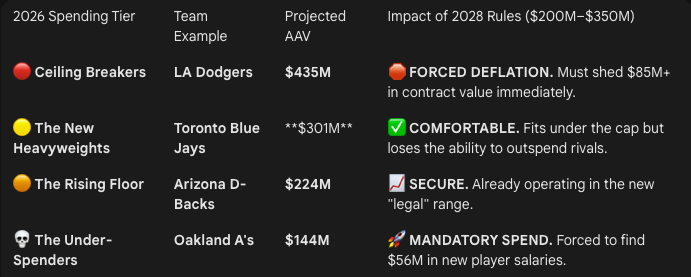
What this table doesn’t show is the emotional impact because payroll isn’t just money it’s leverage, safety, and margin for error.
A hard cap takes away the safety net and a salary floor removes the hiding places so that, together, they force every organization to live in the same weather system.
The Death of the “Ohtani Loophole”
Every era of baseball has its innovations but some happen on the field and some happen in accounting.
The Shohei Ohtani contract became a symbol of the latter.
A $700 million deal, structured so that roughly $680 million is deferred, turned into a luxury tax hit closer to $46 million annually. On paper, it was genius but in practice it created a roster-density advantage no small-market or mid-market team could realistically replicate.
A $350 million cap almost certainly requires flat AAV accounting, not present-value games, and Ohtani’s deal becomes what it actually is: a $70 million annual commitment that eats 20% of a team’s entire budget.
Deferrals still help ownership manage cash flow, but they stop helping front offices stack rosters and instead make this loophole irrelevant.
Why Toronto Looks Strangely Prepared
There is a quiet irony in how the future might land for Toronto who (in many ways) already behaves like a capped team in an uncapped league.
With a projected 2026 AAV north of $300 million, the Blue Jays spend like a heavyweight, but they don’t build like one. Their model is structural, but not impulsive.
Instead of chasing every headline, they’ve poured resources into systems:
The Dunedin Player Development Complex is less spring training site, more research facility.
Sports science and biomechanics labs that are treating pitchers and hitters like long-term engineering projects.
Early extensions that help with buying out arbitration and free-agent years before players become open-market commodities.
Analytical integration that includes embedding data into coaching, not just front-office decision-making.
This is not how teams behave when they expect to outspend mistakes but it is how teams behave when they expect to outthink them.
In a $350 million world, every front office becomes a value hunter but Toronto already lives there.
The New Shape of Team-Building
A $200 million floor changes behavior just as much as a $350 million cap because it ends the “fake rebuild.”
You can’t strip a roster to pre-arbitration players and call it a strategy anymore with a salary floor and you must employ veterans and/or enter the free-agent market. You don’t have a choice because you must carry real payroll risk.
That environment forces something baseball hasn’t consistently demanded in decades which is the intent to contend from everyone.
Suddenly, every team has to signal to its fanbase, its players, and the league that it is trying, not someday, but now.
For players, this changes the decision-making landscape too because if everyone has roughly the same amount of money to offer, money stops being the primary differentiator.
What replaces it?
Stability
Player development reputation
Medical and performance infrastructure
Championship windows
Leadership credibility
Teams stop selling contracts to players to the same degree and start selling cultures.
The Quiet Consequence Nobody Talks About
A capped league doesn’t just change who wins, it would change who survives.
Front offices built on intuition, legacy, or brand power suddenly have to compete in a world ruled by efficiency and the margin for error shrinks as the cost of bad drafting multiplies because the penalty for poor development becomes existential.
In this world, the most valuable asset isn’t a superstar, it’s the $10 million player who produces $50 million in value (looking at your Addison Barger).
What This Reveals About Baseball Itself
Don’t get me wrong, a salary cap, and floor, doesn’t automatically make baseball fair but it will make baseball more honest and pure for the fans.
It will reveal which organizations were using money as a shield, and which were using ideas as a weapon.
It will separate front offices that built systems from those that built spotlights.
It will test whether baseball is truly a game of development, or a game of financial advantage of the owner/ownership group.
The Blue Jays and the Mirror of 2028
If this is the version of the league that emerges in 2028, Toronto doesn’t step into it as a newcomer, but more like somebody who is living there already.
They’ve invested in infrastructure instead of shortcuts, built processes instead of optics, and have constructed development systems instead of relying on saviours.
In a world where every team has the same ceiling and the same floor, that mindset doesn’t just help but it will set them apart.
Baseball likes to pretend it doesn’t change, that it is timeless, and that the game on a sandlot and the game in a billion-dollar stadium are the same thing but every generation gets a moment where the sport looks in the mirror and decides what it actually is.
2028 might be that moment.
It doesn’t need a reset of rules, it needs a reset of values that changes it’s place in history.
A shift from financial meritocracy to mathematical meritocracy where the smartest systems, and not the richest owners, shape the future.
It’s time to stop seeing who is great at spending, and time to see who is great at BUILDING.