Every MLB team’s situation with a new Salary Cap/Floor
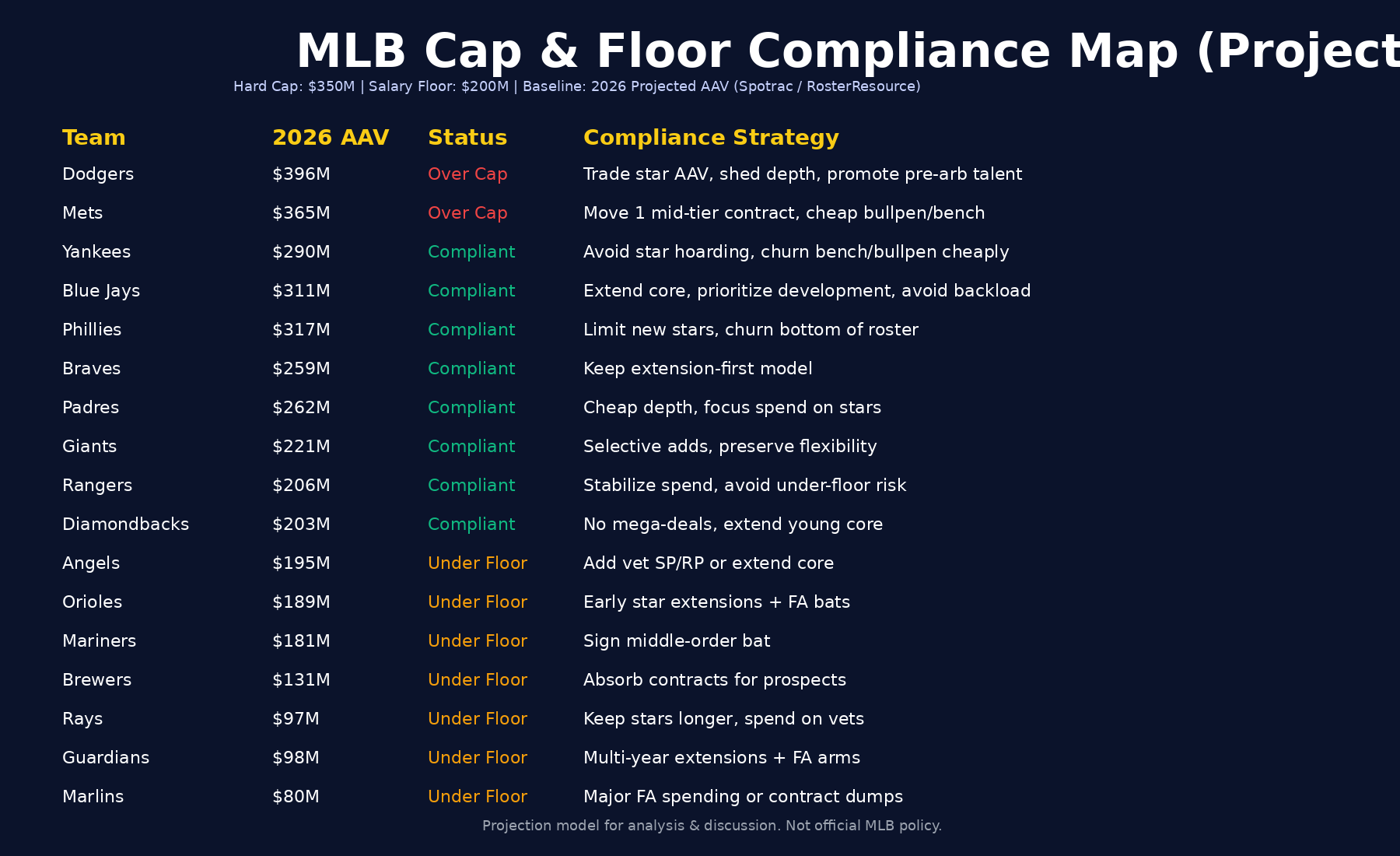
The proposed MLB cap/floor format
In this format, we build a $350 million cap and a $200 million floor that allows for a large window in order to make realistic moves possible in order to become compliant. The assumption would be that there would be a generous window of time to create trade/renegotiate contracts in order to get compliant.
Over the $350M cap (must cut payroll)
Los Angeles Dodgers $396M (–$46M to comply)
What they’d have to do: trade at least one major AAV contract (or multiple mid-tier deals), replace bench/bullpen depth with pre-arb/minimums, and stop carrying “luxury” veterans. In a hard-cap world, they’d also have to prioritize which stars they keep versus how many stars they can stack.
New York Mets $365M (–$15M)
What they’d have to do: same playbook but smaller, shed one meaningful salary (or two mid-tier pieces), avoid adding any paid depth, and lean harder on youth for the last 6–8 roster spots.
In the $200M–$350M “legal” band (already compliant, but must manage future risk)
Arizona Diamondbacks $203M (+$0; barely in)
To stay compliant: avoid a big backloaded mistake, extend core early, and keep using targeted mid-tier adds rather than mega-AAV swings.
Atlanta Braves $259M (in)
To stay compliant: keep doing what they do with extensions, cost certainty, development pipeline. Cap world rewards their model.
Boston Red Sox $266M (in)
To stay compliant: limit long multi-year deals for non-stars; focus spending on premium positions and let depth come from system.
Chicago Cubs $244M (in)
To stay compliant: spend is fine; the key is not turning “pretty good” veterans into 4–6 year commitments that become cap anchors.
Houston Astros $238M (in)
To stay compliant: they’re fine; the job becomes replacing aging production with cheap production without dipping under the floor later.
New York Yankees $290M (in)
To stay compliant: avoid star hoarding, keep bench and bullpen construction cheap, and focus big AAV only on true premium positions while letting internal development fill luxury roster spots.
Philadelphia Phillies $317M (in)
To stay compliant: resist “one more star” impulses; keep churn at the bottom of roster cheap and controllable.
San Diego Padres $262M (in)
To stay compliant: they’d be allowed to keep a star-heavy roster, but would need cheaper bullpen/bench construction and fewer “paid depth” signings.
San Francisco Giants $221M (in)
To stay compliant: smart spot to add selectively; keep flexibility for in-season upgrades without cap panic.
Texas Rangers $206M (in)
To stay compliant: stabilize in-band spending; avoid slipping under the floor if a few big contracts roll off.
Toronto Blue Jays $311M (in)
To stay compliant: they’re built for this…to win via infrastructure + extensions + development. In a cap world, they’d simply shift from “can we outspend mistakes?” to “can we out-develop everyone?”
Under the $200M floor (must add payroll)
Los Angeles Angels $195M (+$5M)
What they’d have to do: add 1–2 real veterans (SP/RP or everyday bat) or extend a core player early to push above $200M.
Detroit Tigers $190M (+$10M)
Must do: veteran innings + bullpen leverage arm is the easiest floor-compliant spend; extensions also work.
Baltimore Orioles $189M (+$11M)
Must do: this forces their hand to either extend stars earlier or sign legitimate MLB vets (not just reclamation projects).
Kansas City Royals $183M (+$17M)
Must do: add mid-rotation arm + everyday bat, or take on a “cap dump” contract from an over-cap team for prospects.
Seattle Mariners $181M (+$19M)
Must do: floor pressure would push them toward at least one meaningful bat (or early extension), not just pitching-heavy roster math.
Milwaukee Brewers $131M (+$69M)
Must do: this is a structural shift to sign multiple veterans, extend key young players earlier, and/or absorb big contracts via trade to buy prospects while meeting the floor.
Cincinnati Reds $137M (+$63M)
Must do: similar with real FA participation plus strategic “bad money for good prospects” trades.
Colorado Rockies $128M (+$72M)
Must do: can’t just pay one guy and would need multiple credible MLB contracts; floor makes “we’re rebuilding” stop being an excuse.
Minnesota Twins $128M (+$72M)
Must do: either extend their own core significantly or spend aggressively on 2–3 mid-tier free agents; floor demands intent.
St. Louis Cardinals $119M (+$81M)
Must do: dramatic shift to add veteran starters + lineup thump and/or take on large deals in trade to accelerate competitiveness.
Pittsburgh Pirates $115M (+$85M)
Must do: big multi-player spend: at least one marquee deal plus several mid-tier vets, or use cap-space-as-asset trades to climb quickly.
Washington Nationals $115M (+$85M)
Must do: same because the floor forces them into the market; easiest path is extending young talent + adding veteran pitching depth.
Cleveland Guardians $98M (+$102M)
Must do: massive change is needed with either multiple extensions (locking in core) plus free-agent adds, or become the league’s top “contract absorber” for prospects.
Tampa Bay Rays $97M (+$103M)
Must do: their model breaks the floor; they’d need to keep/extend more of their own players longer and spend on veterans instead of constant churn.
Chicago White Sox $95M (+$105M)
Must do: invest fast in veteran rotation pieces + bullpen leverage + at least one everyday bat. Floor eliminates perpetual teardown.
Athletics $130M (+$70M)
Must do: add multiple legitimate MLB contracts; easiest is signing veterans and using financial muscle to absorb contracts for prospects.
Miami Marlins $80M (+$120M)
Must do: the most dramatic jump needed will be multiple multi-year deals or a couple huge contract-absorption trades. Floor forces them to “buy” credibility.