Toronto Blue Jays Prospect Highlights: Tools, Risks & MLB Timelines
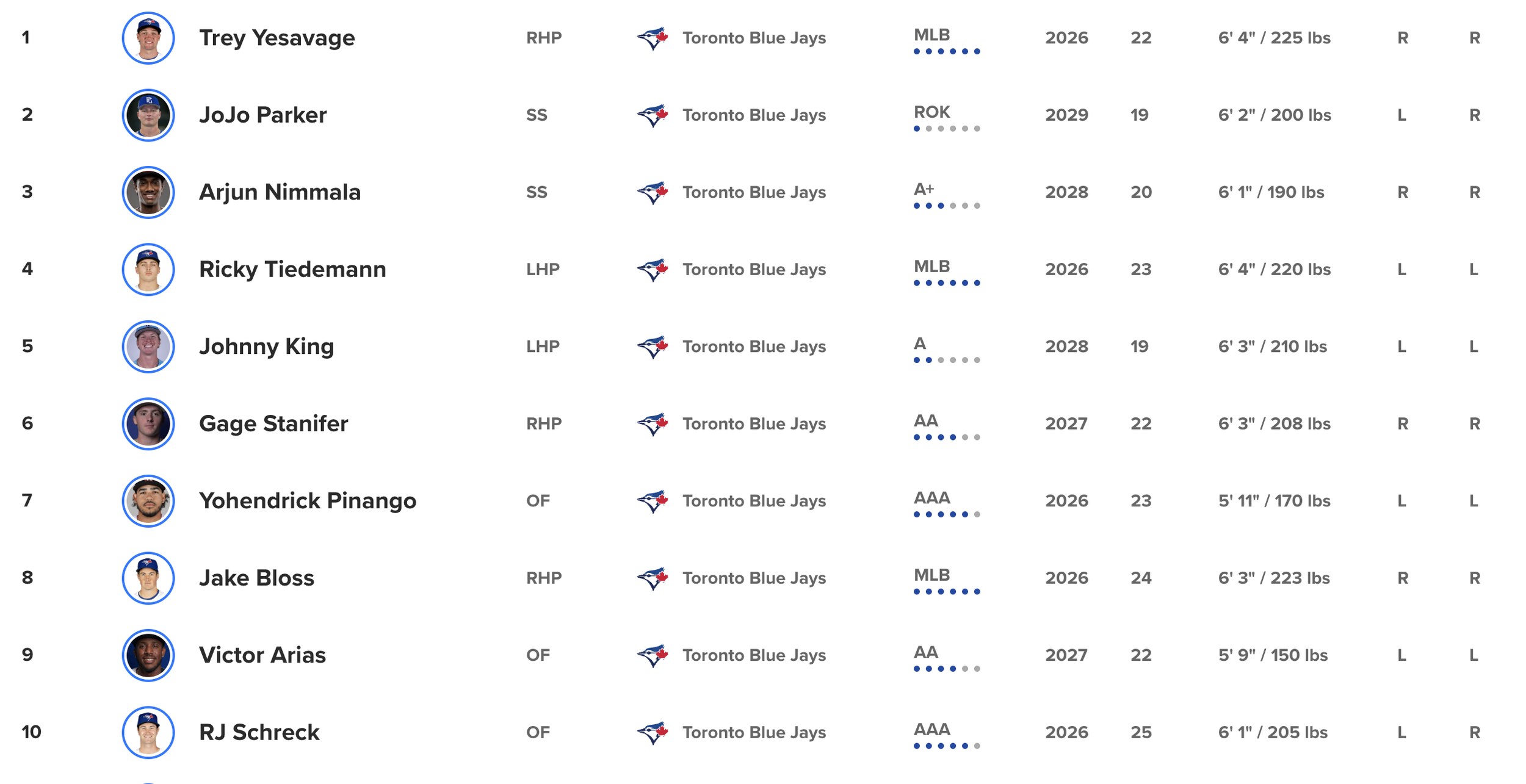
This Isn’t a Rankings Exercise, It’s a Blueprint
There’s a difference between a farm system that excites fans and one that quietly scares other front offices and the Toronto Blue Jays are drifting deliberately into the second category.
This isn’t a system built on one savior prospect or a single “next Vlad.” It’s a system built the way modern contenders build with layers, redundancy, timelines, and optionality. It’s not about how many stars you produce but about how few holes you have to fill externally and how rarely you’re forced into desperation trades.
This is not hype, it’s infrastructure.
Let’s walk it by position the way baseball ops departments actually do.
Catchers: The Unsexy Position Toronto Finally Took Seriously
Catching prospects don’t trend on social media, which is exactly why smart teams hoard them quietly.
Brandon Valenzuela is the clearest near-term contributor. He’s not flashy, or loud, but he receives well, blocks well, throws accurately, and doesn’t give away plate appearances. That profile matters more than ever in a league obsessed with pitch framing and bullpen churn. Valenzuela projects as the kind of catcher pitchers request just like Alejandro Kirk is.
Edward Duran is more developmental but the shape of the player is more familiar: glove-first, bat-to-ball competency, and enough offensive awareness to survive in the bottom third of a lineup. His value comes from being playable, not spectacular.
This matters because catcher injuries derail seasons and Toronto now has insulation.
Likely trajectory: MLB backup / platoon contributors
Why it matters: Stability behind the plate is invisible until it’s gone and Toronto finally understands that.
Infield: This Is the Engine Room of the System
If you want to understand how Toronto’s philosophy has evolved, start here.
Arjun Nimmala still represents the system’s highest-upside position player, but what’s changed is how he’s being developed. The swing decisions improved and the contact quality trended upward. The athleticism has held up so far and he’s not being rushed to dominate, he’s being allowed to grow and that patience shows confidence.
Nimmala’s real value isn’t just the bat. It’s that he projects to stay at shortstop that is organizational gold.
JoJo Parker offers a different kind of certainty with his physicality. His bat speed is real, the power ceiling is legitimate, and while the plate discipline needs refinement, the floor is already higher than most prep bats. Third base fits him naturally, and Toronto doesn’t need him to be something he isn’t.
Juan Sanchez is where things get interesting because the exit velocities are loud and the swing decisions are advanced for his age. The power shows up in games and, though he may end up at third base permanently, the bat profiles anywhere. Sanchez is the kind of prospect whose value jumps fast when the hit tool proves real level by level.
Josh Kasevich is the system’s reality check as injuries have muted his production, but the contact skills never disappeared. The on-base ability remains and, if the power returns even partially, he’s a regular. If not, he’s still useful, and Toronto has learned to value that.
Tim Piasentin may be the quietest future everyday player in the system because his body is mature, the swing is compact, the power indicators are real, and the approach is disciplined. He doesn’t need hype, he needs reps.
Charles McAdoo is volatility with upside because of his aggressive approach, real power-speed combination, and base-running instincts that create value even when the bat isn’t perfect. He’s not refined, but the tools don’t lie.
Big picture: Toronto doesn’t need all of these players to hit. They need two. That’s the point.
Outfield: Athleticism Is the New Currency
The Jays have pivoted hard away from one-dimensional bats and toward players who affect the game without hitting home runs.
Jake Cook might be the cleanest athletic profile in the system with speed, defense, arm strength, and on-base skills that give him real center-field upside. He changes games with both his legs and glove which modern roster construction increasingly values.
RJ Schreck is a hitter’s hitter who has plate discipline, consistent contact, pull-side power and a high floor. He won’t wow you with tools, but he will grind pitchers into mistakes.
Victor Arias and Blaine Bullard are bets on projection as Arias brings explosive strength that still needs polish and Bullard brings speed, switch-hitting, and frame-based upside. Both are developmental, but both fit the organization’s athletic bias.
Yohendrick Pinango is straightforward: the bat must play. If it does, he’s an asset but if not, he isn’t. Toronto understands that clarity matters.
Jake Casey might be the system’s sneakiest value play. He was late-round, and post-surgery, but then suddenly showed power, speed, and defensive competence. These are the players contenders uncover while others aren’t looking.
Starting Pitching: Where the Philosophy Shift Is Loudest
This is the heart of the system.
Trey Yesavage isn’t just the top pitching prospect, he’s the template. His fastball shape, splitter, deception, and command profile all align with modern pitching models. Toronto isn’t chasing velocity alone; it’s chasing discomfort. Yesavage creates it. He’ll likely start in the majors but still needs to be included here.
Ricky Tiedemann remains a high-ceiling, high-risk asset. The stuff is undeniable but the health is uncertain. Toronto no longer seems intent on forcing him into a single role, and that’s progress on their end, so he’ll contribute but the question is how.
Johnny King and Gage Stanifer represent two different developmental paths that lead to the same outcome: usable MLB innings. King offers deception and projection whereas Stanifer offers sturdiness and plane. Teams need both.
Jake Bloss, Silvano Hechavarria, Angel Bastardo, Fernando Perez, and Carson Messina form a deep second tier. Perez’s control is elite. Hechavarria tunnels well. Messina’s curveball gives him a real weapon. None are throwaways.
It’s important to note here that, for both the starting and bullpen pitchers, callups/movement are unpredictable and will be based on need at the time. For example, I see a world where Bloss gets to the Majors again before Tiedemann in the Spring.
Bullpen Arms: Designed, Not Discovered
Toronto’s bullpen pipeline is intentional now.
Javen Coleman brings left-handed power and bat-missing ability.
Adam Macko is a spin-first arm whose stuff plays up in shorter bursts.
Spencer Miles and Ryan Jennings offer velocity with different shapes.
Brandon Barriera remains the ultimate wildcard but the stuff is there if the body holds.
This group doesn’t need to produce stars, it just needs to produce outs.
The Organizational Truth
This system isn’t built to save the franchise, it’s built to support it.
Toronto no longer needs to trade prospects out of desperation, no longer needs to buy depth at retail prices, and no longer needs everything to go perfectly for ALL of their top guys.
That’s how winning organizations operate, because the Blue Jays aren’t chasing hype anymore. They’re building margins that increase likelihood of winning.
Stay in the upper-middle area of the prospect rankings while being willing to spend on some free agents and competitive windows tend to grow.
Sources
https://www.baseballamerica.com
https://www.mlb.com/prospects
https://www.fangraphs.com
https://www.baseballsavant.mlb.com
https://www.baseball-reference.com
https://www.milb.com
https://www.perfectgame.org
https://www.collegebaseballinsider.com