Bo Bichette and the Blue Jays: The Stats, Science, and Signals He’s Staying
Let’s cut to it: When a homegrown star like Bo Bichette hits free agency, the chorus starts. “Will he leave?” “Is his market huge?” “Will the Jays trade him?” But here’s a contrarian truth: everything I’m reading suggests he stays. And not just by default. For real reasons. Let’s unpack them.
1. The numeric foundation: what the data tells us
First, the stats. Bo has been with the Toronto Blue Jays his entire MLB career (drafted 2016, debuted 2019).
He has delivered: career batting average near the .290s and he’s a two-time All-Star.
So from a pure performance standpoint he has earned the right to ask for, and receive, a long-term deal.
Now let’s layer in the franchise decision‐making. The Jays just locked in Vladimir Guerrero Jr. on a 14-year, $500 million deal. That sends a signal: Toronto is in the “commit to core” business. If you’ve handed half-a-billion to one homegrown star, you’re not likely to treat your shortstop as expendable next year.
Also: the team has reportedly said they have the vision of keeping Bichette and Guerrero together so from a purely organization alignment perspective: Bichette + Guerrero=relational/strategic anchor.
Bottom line: the metrics, the commitments, the precedent all point to the “stay” scenario. Now let’s dig deeper.
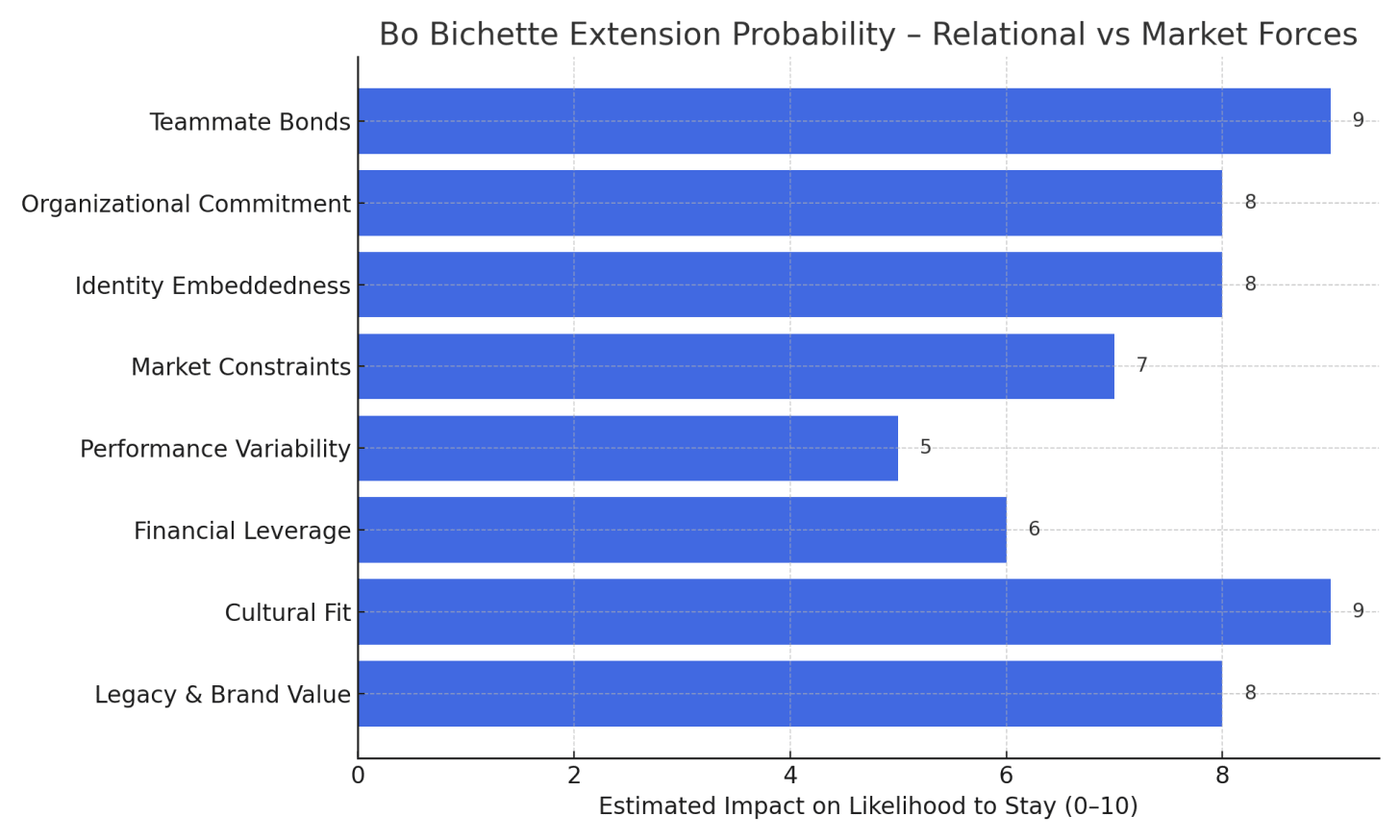
Don’t @ me. I made this myself based on my own scale. It references what I’ve put in this article and nothing else. I’ll use similar with other free agents.
2. The relational/cultural science: why he “wants” to stay
What makes a player sign and stay? Beyond salary and metrics, there are non-financial drivers: identity, relationships, culture, body language, and sense of belonging. Here’s how Bichette checks those boxes.
a) Teammate relationships & shared history
Bo has publicly said: “Vladdy is one of my best friends… we’ve talked about playing together forever since he was 18 and I was 19” which is a big deal because friendships in pro sports actually do matter. If your best teammate is locked in for 14 years and you want to stay with him, that’s a strong motivational anchor.
b) Sentiment and public intent
Multiple sources show Bichette saying he wants to be with one organization his whole career. In one interview:
“It’s been my goal … to be with one organization my whole career, and building a winning culture with Vladdy…”
That kind of language is not casual. It reveals preference. And when you prefer one place and that place is willing… you get alignment.
c) Body-language & clubhouse behaviour (qualitative evidence)
Now we shift to interpretive territory. But let’s do it responsibly.
In the aftermath of a recent big game that we won’t talk too much about, Bichette said:
“I’ll remember this group forever. I think this group taught me what a team is. I think it’s probably the most valuable lesson of my career, so they mean a ton to me.”
That isn’t PR fluff. The phrasing “they mean a ton to me”, “this group taught me what a team is”…that’s relational and language like this shows identity formation.
In group dynamics science, when a person publicly expresses strong emotional attachment to a group, their exit cost increases. They leave not just a job, they leave relationships and identity. Add to that: Bichette has been with Toronto through ups and downs, he’s been a culture-builder rather than just a hire. That raises his affiliation coefficient (so to speak).
Also: his teammates consistently include him in “core” talk rather than as an external add-on. While this isn’t neatly quantifiable yet, it’s observable in media behaviour: showing up at events, talking about the organization first, making references to “we” rather than “I’ll find my next team.” That signals embeddedness, which is a key factor in not leaning toward departure.
3. The organizational incentive & market dynamics
From the franchise side: The Jays are signalling. They already made the expensive commitment to Guerrero. They want to protect their investment and maintain contiguity. The cost of letting Bichette walk (and possibly lose the friend/anchor relationship, the chemistry, the cost of replacement) is higher than many teams face which gives Toronto a strategic incentive to re-commit.
On the market side: Bichette is indeed free next year. He could command a large deal (likely over $180 million) but sources show his market is not unlimited.
Also: the longer you wait, the lower your leverage, especially if you start with an injury-affected season (which Bichette had) that will reduce the “let’s test the market” logic.
Add to that: multiple reports said that the Jays are not shopping him this year prior to the trade deadline even though he was a significant tradeable asset. That public-facing signal reduces external demand, which reduces his outside leverage, thus making staying the rational choice.
4. So: What are the “scientific reasons” boiled down
Relational attachment: Teammate bonds (especially with Guerrero) increase non-financial tie strength.
Identity embeddedness: He identifies with Toronto, has spoken publicly as such.
Organizational commitment: The franchise has locked in other core players, signalling they want him in the mix.
Market constraints: His leverage is imperfect, his positional value may constrain his market, injuries add risk.
Behavioural-psychology signal: His statements, body-language, public emotion align with staying, not just with going.
Opportunity cost: Leaving breaks more than a contract…it breaks comfort, relationships, identity.
Decision cost calculus: From Toronto’s side, retaining him is cheaper (in cultural/organizational power) than replacing him; from his side, staying offers reduced friction and built-in chemistry.
5. What still needs to align (and why it isn’t a guarantee)
Of course: nothing is 100%. He has to physically perform. His 2024 suffered some dip.
He has not yet publicly signed an extension and money matters always. His agent will do their job and Toronto must balance the budget after the Guerrero deal.
But here’s the kicker: Given all these relational, cultural, organizational, and market-dynamics factors, the path of least resistance points to Bichette staying and not leaving.
6. The payoffs if he stays
He remains part of a veteran core with Guerrero, which increases both his legacy and value.
Toronto sustains continuity and chemistry, which is undervalued in baseball analytics (and will likely help on deep playoff pushes in the future).
He avoids the relocation stress, new system, culture shock, and other factors which matter more than fans typically appreciate.
He can build his brand and legacy as “the Jays’ shortstop for another era”, which has long-term off-field value.
7. The bottom line
Yes, the contract is still unsigned. Yes, the market is dynamic. But the most likely outcome for Bo Bichette? Staying in Toronto. Because the science (relationship science, organizational behaviour, market dynamics, performance analytics) all converge that way.
If you’re a fan of the Jays and you’re wondering “will we lose Bo?”, lean in. The odds are well in favour of his staying. That doesn’t mean complacency. It means the organization and the player both should treat the extension as strategic, long-term, and culture-affirming.
Because for Bo, for Toronto, for the many Blue Jays fans who believe in more than just the boxscore…this is the Blue Jay Way.