The Anthony Santander multiverse, and why I’m optimistic
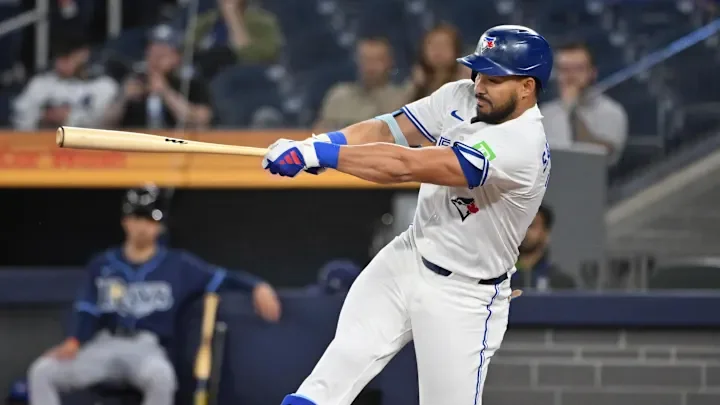
Let’s begin with a simple truth: Anthony Santander is one of those players who makes you believe in baseball when he’s hot and makes you believe in yoga, ice packs, and prayer when he’s not.
Toronto didn’t sign him to be “nice depth”, they signed him to be that guy. A switch-hitting, mistake-punishing, late-inning villain who turns a one-run game into a collective therapy session for opposing bullpens with a swing.
However, now we arrive at 2026 where Santander exists in what scientists refer to as a quantum state of baseball reality. There are three versions of him across three separate timelines and all versions are both plausible and terrifying in their own special way.
Let’s meet them.
Universe One: Prime Santander Returns
The “This Is Why We Bought Him” Timeline
This is the fun timeline because this is the one where Jays fans start sending apology tweets to the team’s medical staff and Ross Atkins gets to walk into a press conference like a man who just successfully landed a plane on the Hudson River.
In this universe, Santander’s shoulder stops being a recurring character in the story. We never talk about it again, and it’s like it never happened.
When that happens, the numbers tell us what kind of monster shows up and it’s exciting.
Back in Baltimore, Santander wasn’t just an All-Star in name, he was an expected-stats darling because his barrel rate, hard-hit percentage, and xwOBA all lived in the “this guy is actually doing damage, not faking it” tier. That’s the kind of profile front offices trust, because it means production isn’t luck but habit, physics, and pure destiny.
Toronto saw that version and said, “Yes. We would like that in the middle of our lineup, please.”
This Santander:
Doesn’t chase much
Pulls the ball with authority
Forces pitchers to choose between walking him or explaining themselves afterward
If he comes back like this in 2026, the Jays’ lineup doesn’t just get better, it gets meaner and tougher. Suddenly, you can’t pitch around anyone and the seventh inning becomes a life choice.
Likelihood: Real, but conditional because this version requires the shoulder to behave like a responsible adult for an entire season, which, historically, it has not always done.
Universe Two: Santander Injury Sequel
Santander 2: The IL Strikes Back
This is the timeline nobody wants, but everyone quietly checks the transaction page for so let’s talk about 2025, because 2025 left receipts.
Santander opened the season hitting like a man trying to swing a bat underwater and then came the shoulder inflammation, the IL, the hopeful return, and finally the back issue that kept him off the playoff roster. It was less “season arc” and more “medical drama with a baseball subplot.”
Here’s the unfun baseball science part: upper-body injuries don’t just cost you games, they steal swing decisions. All of a sudden you’re late, you cheat to get to the ball, you guess at pitches, and suddenly the guy who used to punish fastballs is now fouling them straight back like he’s trying to win a different sport.
This Santander looks like:
Power that only shows up in flurries
Timing that comes and goes
A lineup spot that feels permanently “temporary”
Toronto can survive this version (as proven already) but it changes how aggressive they can be at the trade deadline, how much they trust their depth, and how often fans hear the phrase “day-to-day.”
Likelihood: Higher than optimism would prefer because the body doesn’t lie and it has a pretty solid attendance record in this story.
Universe Three: Healthy, Functional, Mildly Annoying to Pitchers
The “Fine, I Guess” Outcome
This is the sneaky one because this is the version that causes the most arguments on sports radio.
In this timeline, Santander plays 140-ish games and hits some home runs while having a few big moments but yet… nobody’s quite sure how to feel about him.
The advanced metrics tell you what’s happening here:
The hard-hit rate is okay, not great
The barrel rate exists, but doesn’t scare anyone
The expected stats match the surface stats, which is a polite way of saying, “This is exactly what it looks like.”
He becomes a perfectly respectable middle-of-the-order bat, which is great if he’s your fifth-best hitter and mildly stressful if he’s supposed to be your second.
This Santander doesn’t lose you games but he also just doesn’t tilt them in your favor often enough to feel like a franchise-altering signing.
Likelihood: Honestly? This might be the default because this is what happens when talent and health meet in the middle instead of at their best.
What Toronto’s Actually Betting On
Here’s the part that doesn’t get said out loud: the Jays didn’t just sign Santander, they signed up to see multiple universes.
They built a roster that assumes:
He might be a star
He might be a question mark
He might be a very good supporting actor
The smart teams don’t build around the best-case scenario, they build around the most boring one and then celebrate when the fun one shows up.
If Prime Santander arrives, the Jays look like a lineup that can bully pitching staffs in October.
If “Fine Santander” arrives, they need depth, flexibility, and a front office willing to pivot.
f Injured Santander returns, they need contingency plans that don’t involve wishful thinking and a vibes-based trade deadline.
My expert take for 2026
Let’s take out any talk of a specific player and just say that “imagine a player who, in a disrupted 2025 season, you still saw:
Exit velocity profile that didn’t collapse (which I could argue matters more than most average state).
His average exit velocity stayed in the above-league-average range, which means the ball is still coming off the bat with authority.
His hard-hit rate (95+ mph contact) remained competitive with many established middle-order hitters across MLB.
His barrel rate (the stat that best predicts home runs before they happen) dipped, but didn’t crater.
His walk rate (BB%) remained at or above league average which tells me
His pitch recognition didn’t disappear
His eye didn’t collapse
He wasn’t just guessing
His pull side fly ball rate stayed strong.
I think you would be pretty optimistic, which is why I am. I think Universe 3 will blend with Universe 1 and we will see a bounce back campaign that is not making any All Star teams.
For me these numbers show that he just needs a good Spring because timing, unlike raw bat speed, is something that often returns when health does. Additionally, I hope that Toronto understands that he’s probably not going to be elite over 140 games, but he might be over 110-125. Getting him in a platoon situation, with more at-bats against righties where his numbers are far better, will benefit his WAR a ton.
Sources
https://www.sportsnet.ca/mlb/article/blue-jays-introduce-anthony-santander-after-slugger-signs-five-year-deal/
https://www.reuters.com/sports/jays-place-anthony-santander-shoulder-il-2025-05-30/
https://www.reuters.com/sports/jays-place-1b-ty-france-il-activate-anthony-santander--flm-2025-09-24/
https://www.mlbtraderumors.com/2025/10/blue-jays-plan-to-remove-anthony-santander-from-playoff-roster-with-back-injury.html
https://baseballsavant.mlb.com/
https://www.baseball-reference.com/