How the Blue Jays Develop Pitchers: Inside Toronto’s Modern Pitching Philosophy
Inside the data, discipline, and design thinking that drive the Blue Jays’ modern pitching revolution.
Inside the data, discipline, and design thinking that drive the Blue Jays’ modern pitching revolution.
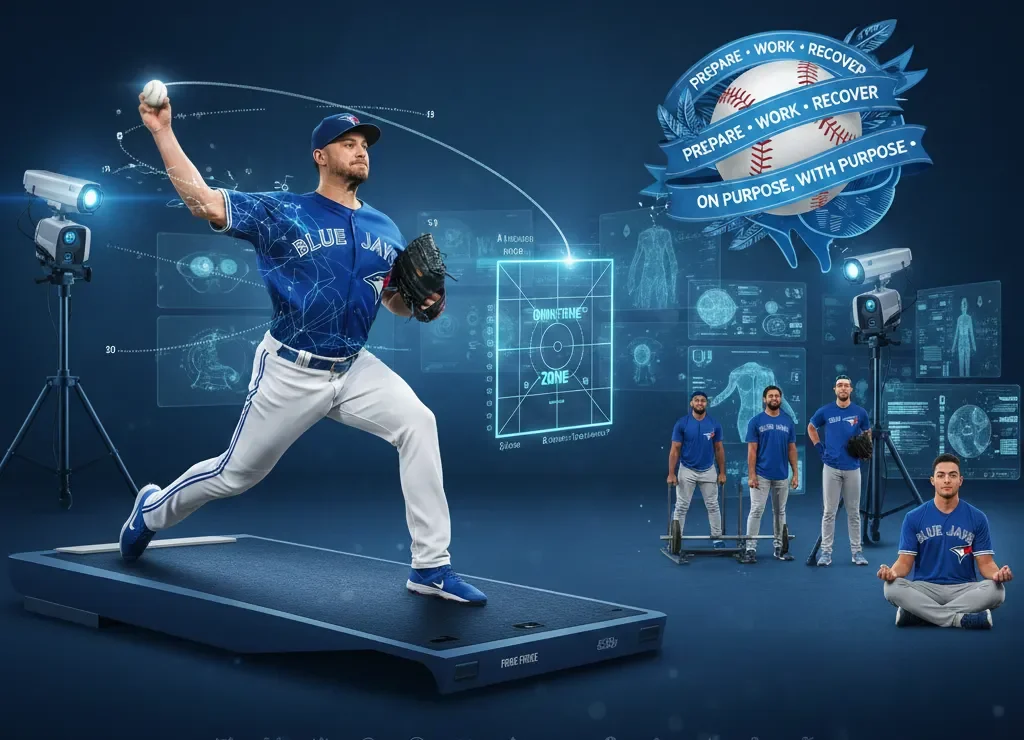
If you want to understand where the Blue Jays are going, don’t start with what Dylan Cease is capable of or Trey Yesavage’s upside. Start in Dunedin, in a biomech lab, with a bunch of nerds pointing cameras at some 19-year-old throwing a fastball, because quietly, over the last few years, Toronto has been trying to answer one big, painful question:
“How do you stop breaking pitchers and start building them?”
This is the deep dive: what the Jays actually believe about pitching now, how they train arms from A-ball to the big leagues, and why this philosophy is going to shape what you see on the mound for the next decade.
From chaos to a clear identity: “We own the zone first”
The Jays didn’t get here because everything was going great. They got here because things weren’t.
In April 2025, MLB.com’s Keegan Matheson laid it out about how recent success stories on the mound either faded or got hurt. Alek Manoah went from frontline ace to struggling and eventually to Tommy John. Top pitching prospects Ricky Tiedemann, Landen Maroudis and Brandon Barriera all needed surgery in the same season.
It looked like a system-wide red flag.
Enter Justin Lehr, the new Minor League pitching director. Lehr’s first move wasn’t “more velocity” or “more sweeper sliders.” It was something way more boring and way more important.
New mantra: “We own the zone first.”
Lehr’s view of what a “Blue Jays pitcher” looks like:
Command before cosmetics. They want their guys in good counts, limiting free passes, long before they start obsessing over spin efficiency and seam-shifted wake.
Patience with young arms. Lehr talks about letting a young pitcher’s current arsenal “ride” before stepping in with heavy tinkering. That’s a big change from the “new toy every offseason” approach some orgs fall into.
Holistic velocity building. He’s explicit that chasing velo with one magic tool is how you break arms, not build them. Instead, they’re attacking it from all angles: delivery efficiency, recovery, strength, and workload management.
Director of Player Development Joe Sclafani echoes that as last year’s draft class already came with at least one “now pitch” and often a big fastball; the Jays see their job as refining that, not bulldozing it and starting over.
That’s the philosophical pivot: command and health → then velocity and nastiness, not the other way around.
The High Performance department: build the body, protect the arm
Zoom out from the mound and you hit one of the most quietly influential pieces of this whole puzzle: the High Performance department.
Sportsnet did a deep dive on this group a few years ago, calling it an “interdisciplinary collection of specialists” covering everything from strength and conditioning to psychology.
A few things matter here:
It’s run by sports psychologist Angus Mugford, brought in by Mark Shapiro and built out to a staff of over 40 across the org.
Their mantra: “prepare, work, recover”, and another one: “do things on purpose, with purpose.” Every rep, every meal, every recovery choice is supposed to have a reason.
They individualize everything. Gone are the days of every pitcher doing the same lift, same throwing routine, same recovery. Each player gets a tailored plan.
Steve Pearce gave maybe the most relatable example when he went from being the “colonize the squat rack” guy to doing what looks like simple, precise movement work like single-leg deadlifts with kettlebells, sled pushes, balance-heavy exercises and joking it didn’t even look like he’d done anything.
That’s the point because this isn’t “beach muscle” training, it’s durability and movement quality which are the foundation of a delivery that can survive 180+ innings.
Mental performance, nutrition, and sleep all get baked in too:
Dieticians reshaped food offerings across all affiliates and even coordinate with visiting clubhouses so players have performance-friendly options on the road.
Mental performance coaches work on routines, quieting the mind, and getting pitchers to think less, not more, when they’re on the mound.
The club actively studies and optimizes sleep by incorporating flight timing, education on sleep habits, tactical naps, etc because late-night baseball and travel is, by default, terrible for recovery.
In other words: the Jays don’t see pitching development as just “teaching a slider.” They see it as building a human being who can withstand the modern game.
The Dunedin pitching lab: motion capture, force plates, and “stealing” from Vanderbilt & Wake
Now we get to the part fans picture when they hear “pitching lab.”
In 2021, Toronto unveiled its brand-new player development complex in Dunedin, which is a nearly $100 million project that Mark Shapiro flat-out called “the best complex in all of Major League Baseball,” designed specifically to help bring “World Series championships back to Canada.”
Some key details:
Outside: six full fields, two half fields, 20 mounds, 12 covered batting cages, a covered turf field and a “speed hill.”
Inside: three sport science labs, including a dedicated pitching lab, an indoor/outdoor two-floor weight room, hydrotherapy, and full minor- and major-league clubhouses.
This wasn’t designed in a vacuum. The Jays essentially went on a technology and training road trip:
They studied Wake Forest’s groundbreaking motion-capture lab, where a full-time biomechanist and advanced tech are baked into player development.
They went to Vanderbilt, where Edgertronic cameras, Rapsodo units, and a ground-force plate mound are used to fine-tune mechanics and improve breaking ball consistency.
They visited Cressey Sports Performance, Driveline, Duke, and others, asking how to implement all this tech without drowning players in data.
Toronto bullpen coach and pitching development director Matt Buschmann has been blunt about the challenge: it’s not enough to own the toys; you have to use them to actually change training plans and make pitchers tangibly better.
GM Ross Atkins has talked about learning from the college game which often has to develop arms faster and leans heavily on biomechanics and motion capture in order to “rebuild” the Jays’ plan and philosophy for building pitchers. The goal is fewer arms “falling by the wayside,” more durability, and more guys throwing harder, healthier, and more often.
Meanwhile, across MLB, tech like Rapsodo and Edgertronic has become standard, with pitchers like Ryan Tepera flat-out saying, “That’s the new phase of baseball that we’re in.” Toronto’s been part of that wave, gathering spin-rate and movement data and feeding it back to players in real time.
So, when you hear “Blue Jays pitching lab,” you’re talking about:
High-speed cameras tracking every frame of a delivery
Force plates measuring how a pitcher uses the ground
Detailed motion-capture runs every few weeks for mechanical check-ins
Data integrated back into actual training, not just pretty charts
Owning the zone before owning spin
Here’s where it gets interesting: the Jays have all this tech… and yet their first step under Lehr is almost old-school.
Own the strike zone. Stay in good counts. Then get fancy.
That’s not anti-analytics. It’s actually the logical extension of them.
All the high-speed video and spin-axis charts in the world don’t help if you’re 2–0 on every hitter. Lehr flatly says you can’t “outrun being in bad counts,” even with big-league stuff.
So the progression looks like this:
Foundation: command, repeatable delivery, efficient recovery.
Layer 1: velocity work, but driven by overall movement quality and strength, not some one-size-fits-all “velo camp.”
Layer 2: pitch design by tweaking grips, shapes, usage, and tunneling with Rapsodo/Edgertronic data.
And they’re very aware of the “too much information” problem. Vanderbilt pitching coach Scott Brown, who was one of the key influences on the Jays’ lab design, flat-out says that if a guy has his head buried in numbers while the guy next to him is just competing and executing, the data starts to hurt more than help.
So the Jays’ philosophy, in plain English:
Technology is the microscope, not the religion. Command is still the sermon.
Case study: Aaron Sanchez and the six-man rotation
If you want a real-world example of this philosophy in action, look back at Aaron Sanchez in 2016.
The High Performance department, front office, and coaching staff came into that year with a plan: Sanchez would start the season in the rotation, then move to the bullpen to limit his workload and protect his long-term health. He’d never topped 133.1 innings in a season; pushing him near 200 felt risky.
Then Sanchez went out and shoved.
He ran a 2.71 ERA through his first 21 starts, made the All-Star team, and looked like one of the best young arms in the sport. More than half those starts went seven innings or more. The innings started piling up.
The original plan said, “shut it down or move him to the pen.” The data and the player said, “I’m handling this.”
Sanchez had leaned all the way into the High Performance model: strict conditioning, a precise daily eating plan, and full buy-in to the department’s routines. Mugford called him a “role model” for how to look after body and mind.
The Jays changed course:
They went to a six-man rotation down the stretch.
They carefully mapped out his final two months to build in more rest between starts.
Sanchez stayed in the rotation and finished as the American League ERA leader with 203.2 innings pitched.
That’s the philosophy in action:
Data and health concerns inform the plan.
The player’s work and performance can modify it.
The solution is creative structure (six-man rotation), not just hitting the eject button.
It’s not perfect, and yes, injuries still happen but you can see the framework.
What this means for the next wave of Jays arms
So how does all this translate to the pitchers you’re actually going to see?
Prospects are going to come up looking more like “strike-throwers with a plan” than raw stuff merchants with 5.0 BB/9. Lehr’s “own the zone” mantra is meant to give them a floor.
Rehab guys like Hyun-Jin Ryu have already talked about how much emphasis they put on conditioning, mental resilience, and long-term work building back from Tommy John is the exact kind of patient, holistic approach this infrastructure is built for.
Imported arms (your Dylan Cease types, your trade-deadline gets) walk into a world where biomechanics, pitch design, and recovery are all under one roof instead of scattered across private coaches.
And maybe most importantly: this philosophy makes it easier for the front office to bet on upside.
If you believe in your ability to:
Clean up a delivery
Build velocity without wrecking an elbow
Add a better breaking ball with lab feedback
And keep guys on the field with smart workload management
…then you can take on project pitchers with flaws but huge ceilings and trust your system to do the work.
Not perfect, but on purpose
If you strip away the jargon, the Jays’ modern pitching philosophy is pretty simple:
Build the human first.
Own the zone.
Use tech to sharpen, not define, the pitcher.
Treat health and performance as the same problem, not separate ones.
Is it flawless? No. They’ve still had high-profile injuries, stalled prospects, and seasons where the pitching wasn’t good enough. No system in 2025 and beyond will be bulletproof.
But the difference is that this isn’t random anymore. This isn’t “hope the arm holds up” and “tell him to throw harder.”
Toronto has a clear identity and an entire physical and philosophical infrastructure behind it from a Dunedin lab built with input from Vanderbilt and Wake Forest, to a High Performance staff that touches everything from sleep to psychology, to a Minor League pitching director whose first principle sounds like something your Little League coach would shout from the dugout.
For a franchise that spent years searching for a pitching blueprint, that last one might be the most important development of all.
If you’re a Jays fan wondering whether the next wave of arms will be any different, the answer is this:
They’re not just throwing harder.
They’re throwing with purpose.